The Storm Report

  • Home
  • Radio Weather
  • Staff
  • Interactive Radar
  • Contact Us

January 10, 2021 By Steve Hamilton

Winter Weather Warnings, Explained

Since it is winter in the Northern Hemisphere, we thought it would be a good idea to explain a little bit about the variety of winter weather watches, warnings and advisories. During these cold months, you’ll probably hear some of these terms in the weather forecast, but we will give you a better idea of just what they mean.

The first thing to keep in mind, is that the National Weather Service sets its watch, warning and advisory criteria depending on location or region. For example, snow in New York City is not as big a deal as it would be in a city in the south, where bad winter weather conditions are less frequent. This mostly has to do with what are considered typical types of winter weather for a specific area, and what people are accustomed to dealing with. While 3 inches of snow in New York might be a nuisance, 3 inches of snow in Dallas or Atlanta might cause much bigger problems because people there may not be used to that kind of weather.
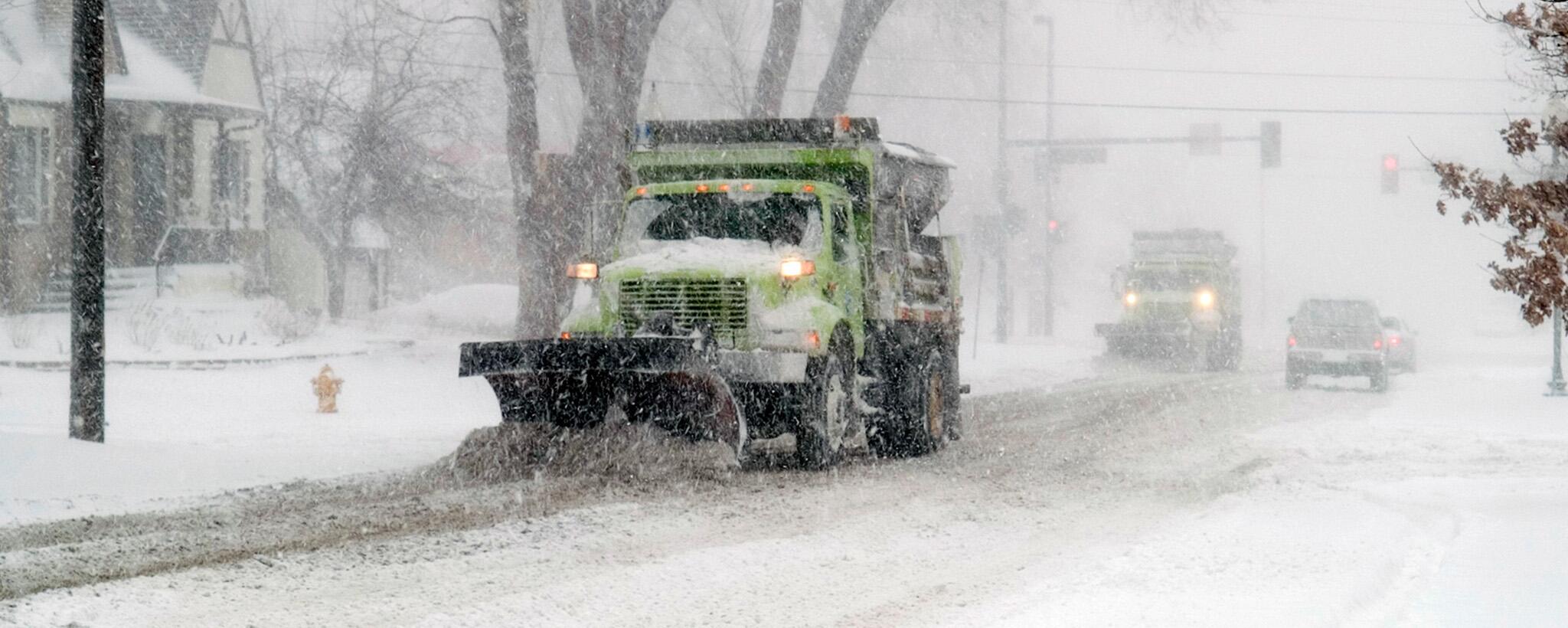

Image via ready.gov
Image via ready.gov

Watches and Warnings are issued by National Weather Service regional offices, and they go by county, and usually cover a wide area, often including several states.

Here are a couple of watches and warnings you will hear a lot over the winter, if you live in a snow-prone area: Winter Storm Watches, and Warnings. The difference between a Watch and a Warning is straightforward. A Watch means conditions are favorable for dangerous weather conditions. A warning means winter storm conditions are imminent or occurring.

First off, here’s the NWS definition of a “winter storm”: 5 inches or more of snow or sleet in a 12 hour period, or 7 inches or more of snow or sleet over a 24 hour period. There are a few other elements that could come into play, like enough ice accumulation, mainly freezing rain, to cause damage to trees and power lines, or a life-threatening or damaging combination of snow and ice, with gusty wind.

Now here are a few you might not be familiar with. For example, an “Ice Storm Warning”. Those aren’t much fun, and they’re issued when a quarter inch or more of ice accumulation is expected. Usually, that will be freezing rain, which is precipitation that falls as liquid, and freezes when it hits the surface. A quarter inch of ice is heavy enough to cause tree damage and power outages, not to mention very hazardous driving and walking conditions.
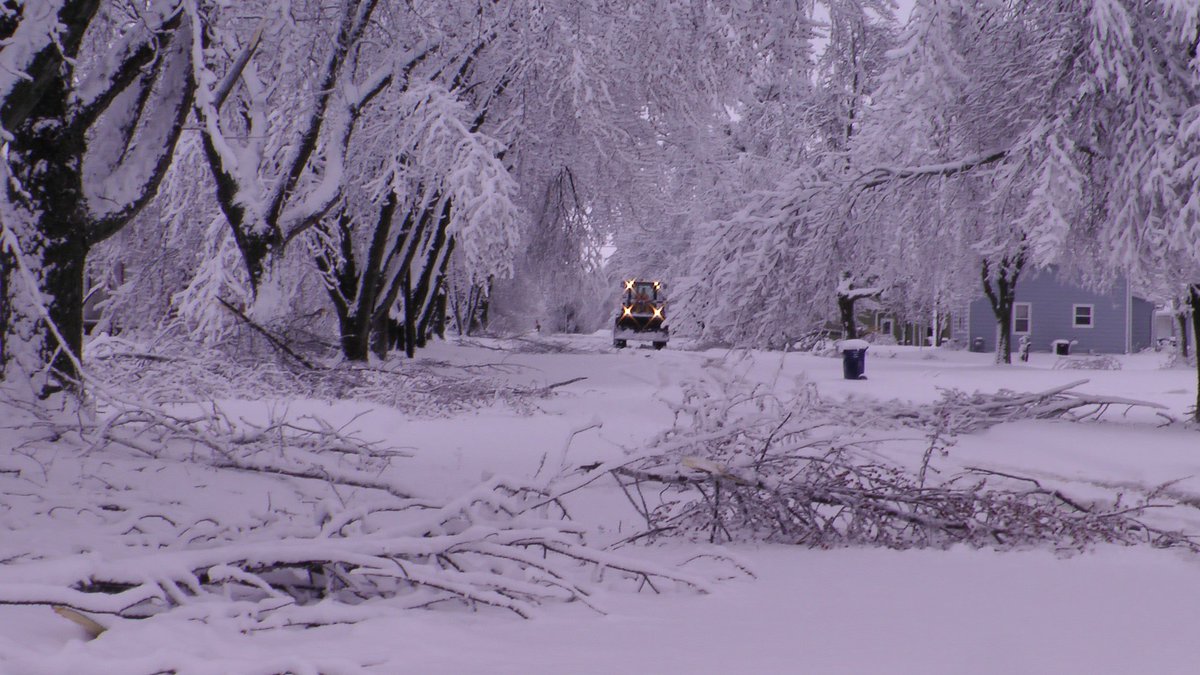

Image via NOAA National Weather Service.

You have probably heard the term “Blizzard Warning”. So, what exactly is that? A Blizzard Warning is a bit different from a Winter Storm Warning, mainly because focuses more on wind and visibility. Basically, winds of 35 mph or greater, and visibility of a quarter-mile or less, constitute a Blizzard Warning.

There is a prevalent misconception that a Blizzard Warning means it will be extremely cold, or there will be heavy snowfall. However, there is no temperature requirement for a Blizzard Warning, and snow does not actually have to be falling. Snow that is already on the ground, combined with the wind, could meet the low visibility requirements for a Blizzard Warning.

The next one does have to do with cold, and that is a “Wind Chill Warning”. It means wind chill temperatures of minus 25 degrees or lower are expected in the next 12 to 36 hours. During a Wind Chill Warning, you should either stay in a warm place, or have the right type of clothing to protect yourself completely against the cold. Even though it may be sunny, wind chill can cause frostbite on exposed skin, and possibly hypothermia, quite quickly.

Those are the biggies. Now, you might hear the word “Advisory” associated with hazardous winter weather. That means the dangerous winter conditions we talked about are likely, but not bad enough to meet the criteria for a warning. But that does not mean it won’t be dangerous. And again, that depends on where you are located. An advisory for snow in New York might qualify as a warning for a place like Atlanta.

This is a lot to remember. But when you hear the words “watch”, “warning” or “advisory” in a winter weather forecast, you should pay close attention to the forecast so you’ll know what to expect and figure out how the conditions will affect your situation.

Always have enough food, water, medicine, protective clothing on hand, and a well-maintained vehicle to get you through any weather trouble.

The National Weather Service website has all of this detailed out, including current maps showing you where the rough spots are.

Sources:

National Oceanic and Atmospheric Administration / National Weather Service
https://www.weather.gov/lwx/WarningsDefined

https://www.weather.gov/bgm/WinterTerms

Filed Under: blog-3

December 23, 2020 By Steve Hamilton

The Most Important Forecasts Of The Season!

One of the biggest questions this time of year is: “Will we have a White Christmas?” Lots of people dream of a White Christmas, as the song goes. And, just about everyone has their own idea of what that is.

For some, it means it has to actually snow on Christmas Eve or Christmas Day, with enough accumulation to completely cover the ground. Other folks are satisfied with just some snow on the ground, even if it isn’t snowing. And, there are people who are happy just to see a few flakes fall from the sky.

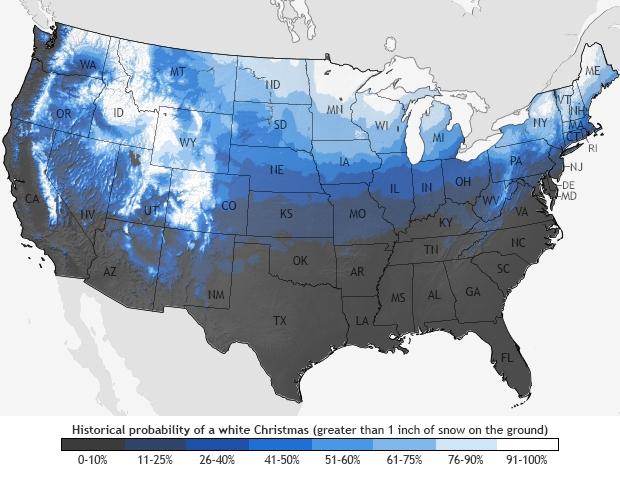
Well, believe it or not, there is, in fact, a scientific definition of what counts as a White Christmas. According to the National Weather Service, a White Christmas is defined as having one inch or more of snow on the ground Christmas morning. So, it doesn’t actually have to be snowing. That’s the official word, anyway. But, if you have your own standards, that’s cool too.


This map shows you the statistical probability of a white Christmas, based on the 1981 to 2010 normal snowfall. (Source: National Weather Service. www.weather.gov/dvn/ChristmasSnow)

With the big day coming up fast, we have some predictions on where to expect a White Christmas, based on the official definition. 

As you probably expected, the southern states won’t have any snow on the ground Christmas morning. No big surprises there, however, thanks to a cold front that’s expected on Christmas Eve, it will at least be a cool Christmas Day for most of the southern tier of the country. Now for the snow, and we’ll go from west to east.

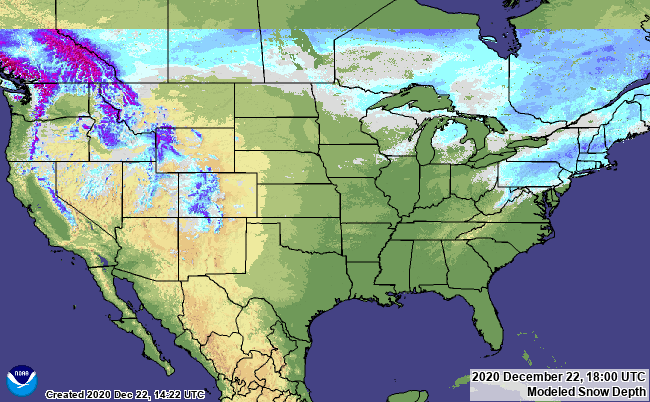
There will be at least 1 inch of snow on the ground in the Sierra Nevada and Cascade mountain ranges, as well as the Northern and Central Rockies, including the Tetons and Bitterroot Ranges.


This map shows you where there is currently snow on the ground, and the scale shows the snow depth. (Source: NOAA)

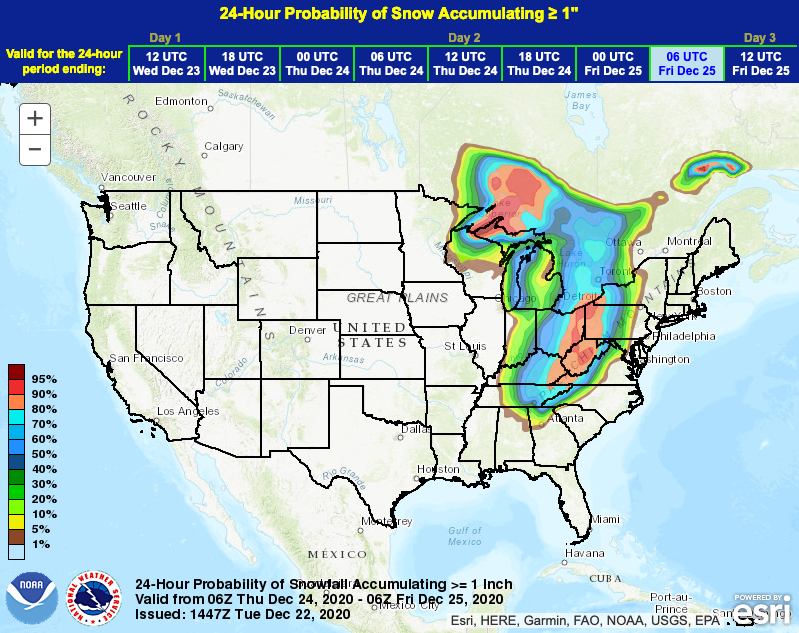
There’s a big storm brewing in the Northern Rockies, and that’s expected to bring snowfall to the Northern Plains and the Great Lakes. That should give those areas enough snow to call it a White Christmas.

That same storm will bring a lot of rain to the eastern third of the country from coastal New England down to the Gulf Coast. But, cold air will come in behind it, providing a chance for at least an inch or more of snowfall for the Appalachians, the Ohio Valley and up through western Pennsylvania and New York State. And there’s also plenty of snow on the ground from the last storm over much of New England, with more expected.

As for the rest of the country, the higher elevations of the Intermountain West should have enough, but the lower areas will be dry. And the chances of a White Christmas are low for most of the Central Plains and the middle Mississippi Valley, eastward into the Carolinas and the southern parts of the Mid Atlantic states.

Remember, that’s where we expect a White Christmas by the official definition.


This map shows you where at least 1” of new snowfall is expected by early on the morning of December 25. (Source: NOAA Weather Prediction Center)

Now, for the really important news. We’ve checked the weather conditions at the North Pole, because Santa is getting the sleigh packed up and the reindeer fed for the long trip. It’s clear and cold up there, and the Elves are hard at work. And Donner is in the gym, for a last-minute workout, because he had a little too much pumpkin pie over Thanksgiving.

The weather for Santa’s journey should be fine, with that big winter storm over the northern states getting out of the way just in time.

As you probably know, it’s dark all the time at the North Pole during the winter months because of the Earth’s tilted axis, which causes the seasons. But, not to worry. Santa always has plenty of light thanks to the North Star, and Rudolph’s nose, which we understand is operating at full power. 

And remember, the good folks at NORAD will be tracking Santa again this year online at https://www.noradsanta.org/!

Whether you have a white Christmas or not, we wish you a merry one, and a happy, safe holiday season.

Filed Under: blog-3

December 6, 2020 By Steve Hamilton

Welcome To A La Niña Winter!

Just about everyone has heard of El Niño.  But what about its opposite, La Niña?  What is this climatological phenomenon?  How does it work?  And, what effect will it have on our weather over the next few months?

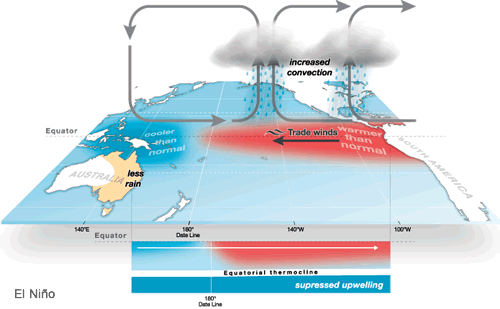
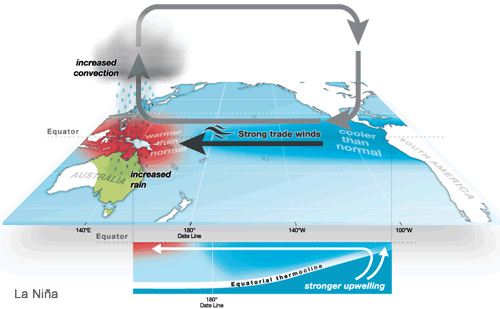
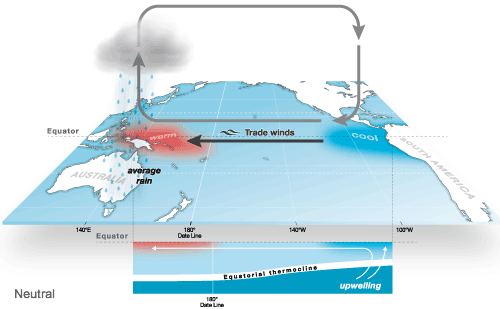
La Niña is just one phase of the “El Niño Southern Oscillation”, or “ENSO”, which is a pattern of air pressure and ocean currents across the Central Pacific Ocean. The opposite of La Niña is El Niño. In between is what we call the “neutral” phase. In between those are the “transitional” phases. El Niño is the warm phase of this circulation, with relatively warm water piling up in the Eastern Pacific, while La Niña is the cool phase.

ENSO doesn’t just affect the Eastern Pacific though. It’s one of the most influential circulations in North American weather.

The National Oceanic And Atmospheric Administration (NOAA), along with other worldwide scientific agencies, monitor ocean temperatures and air pressure constantly. They do this in order to determine which phase of ENSO we’re in, and roughly how long it is expected to stay in that phase, or change back to the opposite phase.

This back and forth pattern has been known for centuries. Thanks to modern technology, including satellite data and automated ocean buoys, it can be tracked and predicted more accurately than ever.

The oscillation isn’t really predictable in the long term. We may see a La Niña go from neutral, then right back to La Niña, or stay in an El Niño phase for several seasons. Or, it may stay neutral for a while. Or, we might see a “mild” or “super” phase.

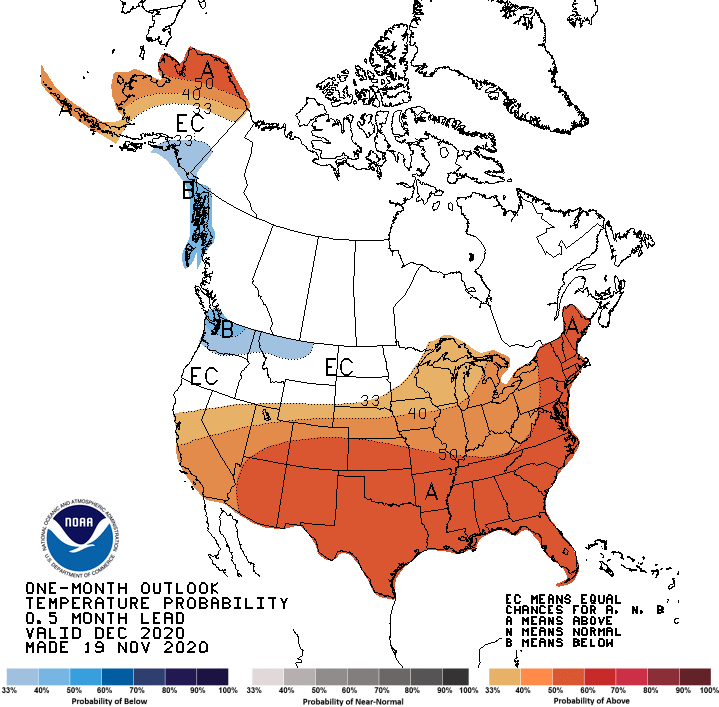
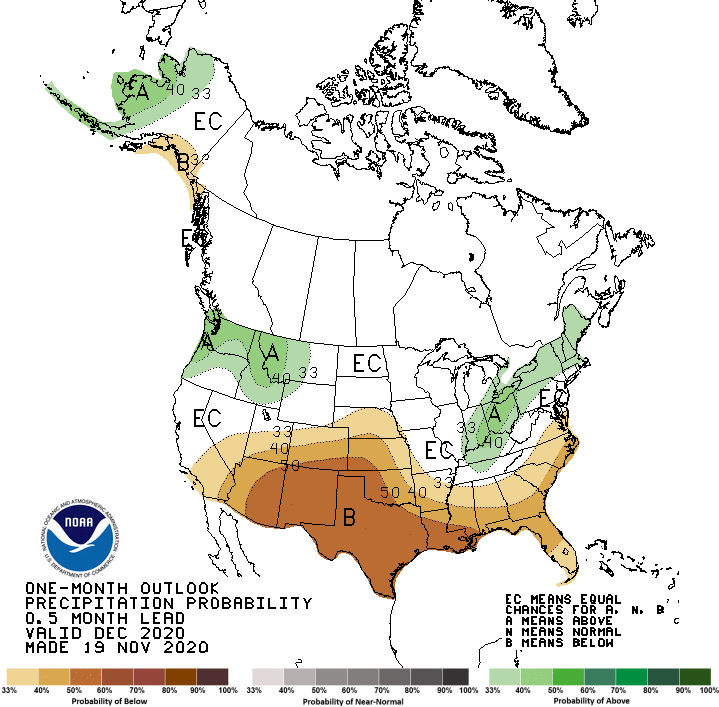
According to recent data from the Climate Prediction Center (CPC), La Niña is in full swing, with good chances of it staying in place through March 2021. Here’s a look at what this might portend for the average weather this winter. These are the latest climate maps for the next month, from the CPC.


1monthtemp

1monthprecip

Here’s a quick look at how ENSO works. During a La Niña, we get colder ocean water piling up in the Eastern Pacific. This will tend to cause an east-to-west flow of air along the Equator. This is because cold air is more dense, with higher surface pressure, and will tend to flow toward lower pressure. The movement of air also contributes to the movement of the ocean water below, and vice-versa, in a feedback loop. 

With La Niña, wind blowing from east to west will move surface water from the Eastern Pacific. So, colder water from below will rise up to replace it, causing a loop which continues until the pattern is disrupted.


The opposite holds true for El Niño, with warmer water in the Eastern Pacific, and a west-to-east atmospheric flow. The warmer water near western North America will tend to cause lower air pressure, bringing more favorable conditions for formation and precipitation for the southwestern and southern parts of the country. With La Niña, we get cooler air and water, which suppresses cloud development, and thus, less rain over those regions.

Things get tricky with these changes, because different effects will be felt over different regions of the USA. While the western and southern states are often more dry and warm during a La Niña, the northern and eastern regions may get an increase in precipitation and a decrease in temperature. During El Niño, it may be the opposite.

Keep in mind, when we talk about warmer or colder, and wetter and drier, that refers to “seasonal averages”, since each phase of ENSO usually lasts for several months. So, blaming ENSO for any one short-term weather event is usually not a good idea. 

Also keep in mind that ENSO is just one of many regularly-occurring ocean/atmosphere circulations around the world, which affect our weather in the United States. But, ENSO tends to get the most attention, since the impacts are usually more evident over three-month periods.

That brings us to the current situation. The CPC started seeing indications last summer of an approaching La Niña phase. Now that sea surface temperatures and other data have confirmed the things, a “La Niña Advisory” has been issued by the CPC.

From their powerpoint presentation of November 16, 2020: “La Niña conditions are present. Equatorial sea surface temperatures are below average from the west-central to the eastern Pacific Ocean. The tropical atmospheric circulation is consistent with La Niña. La Niña is likely to continue through the Northern Hemisphere winter, 2020-2021.”

They indicate a 95% chance that La Niña will be present from January through March, and a 65% chance of it continuing into spring of next year. NOAA and other scientific agencies not only measure sea-surface temperature, but also at various depths. Likewise, while surface winds are measured, wind direction and speed are also measured higher up, to determine the strength of the ENSO phase. 

With the onset of a La Niña winter, generally speaking, we can expect a warmer, drier weather pattern for the western and southern states, and somewhat cooler and wetter conditions for the northern and eastern areas.

The CPC provides a seasonal outlook, and also a month-by-month prediction of weather trends, largely based on the ENSO circulation. But keep in mind that other atmospheric trends come into play. In other words, La Niña won’t control our weather completely.

We mentioned before that while ENSO definitely has an impact on regional weather across the country, it’s measured or observed, then averaged-out on a seasonal basis, or over the duration of the ENSO phase. That means, short-term weather isn’t predicted simply based on whether we’re in a La Niña, Neutral or El Niño.

In fact, over the years, trends have been observed that are exactly opposite what we’d expect from a certain ENSO phase, usually due to other contributing factors well away from North America. All of the various circulations are interwoven, or “teleconnected”. That is to say, predicting an oncoming ENSO phase is usually easier than predicting the daily weather for any given city.

To sum it all up, heading into a La Niña winter, we should, on average, see more precipitation and cooler weather for the northern and eastern states, and warmer, drier weather for the south and west. You can track all of this by looking up The Climate Prediction Center online. Their site is constantly updated with seasonal rainfall and temperature forecasts.

Sources:

Climate Prediction Center (One-Month Outlooks & Winter Outlook and Graphics) La Nina specifications, La Nina Advisory and associated data La Nina/El Nino Status 1 La Nina/El Nino Status 2

Filed Under: blog-3

Real Personalities

When looking to add a trusted source for weather, you want someone who can connect with your audience.   Our meteorologists are also on-air personalities.    The Storm Report team delivers a fresh sound with relatable information to get through the day.  We are your staff meteorologists.

The Storm Report

Follow us on:

Real Passion

We love weather.   No two days are the same.   That fuels our passion.   When weather is serious, you will hear it in our voices.    No text-to-speech computer forecasts.   No robotic audio.   Humans connect with humans and that is what radio is all about.

Real Life

When your community hosts special events, the weather is always a factor.   We weave timely information into your forecast when it comes to fairs, parades, fundraisers or remote broadcasts.    If your weather is sponsored, we are the spokesperson, helping your client earn results.

Copyright © 2026 thestormreport.com