The Storm Report

  • Home
  • Radio Weather
  • Staff
  • Interactive Radar
  • Contact Us

February 13, 2021 By Jennifer Narramore

Historic Winter Storm and Life Threatening Cold To Hit the U.S.

Over 100 million Americans are currently under winter-related watches, warnings, or advisories as a significant winter storm moves out of the Pacific Northwest and across the Rockies. This system will be diving through the Plains and Deep South and then moving up through the Ohio Valley and into the Northeast.  The Arctic air mass we talked about in last week’s Meteo Monday continues to penetrate further southeast, so not only are we dealing with accumulating snow and ice for several areas across the country but the potential for record-breaking cold.

This storm has packed a punch across parts of the Pacific Northwest. Portions of Oregon have picked up over an inch of ice-accretion, which has led to nearly 300,000 power outages. 8-10” of snow has fallen across the Seattle Metro Area, and over a foot has fallen across the Vancouver, WA metro.

CRAZY! The weight of the snow collapses the roof of this boat dock in the Willamette River. House boats tipping, too. At the end of the vid, one man is escaping w/ what looks like a pet kennel! I hope everyone is safe. Caution: language

📷: John Kinsman around 4AM@fox12oregon pic.twitter.com/fETGx8YNzA

— Brenna Kelly (@BrennaKellyNews) February 13, 2021

The National Weather Service in Dallas, TX, is calling this a historic storm. “Major impacts resulting in severe stress to the region`s infrastructure (particularly power, water, and highways) are likely. Regional travel will be crippled for days.” They are also saying that these will be some of the region’s coldest temperatures since the December 1989 Arctic Outbreak. 

Portions of Louisiana that are still recovering from the devastating 2020 hurricane season will now have to go through a significant ice storm late Sunday night into Monday. NWS Lake Charles is projecting 0.10” to 0.30” of ice accretion across their County Warning Area (CWA). This will lead to tree damage, power outages and make driving impossible.
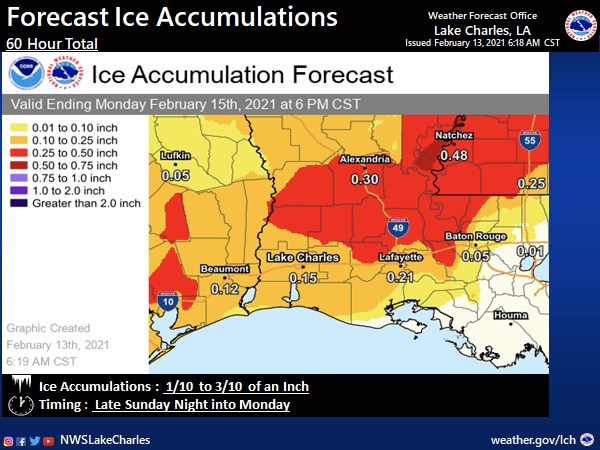

Image via NWS Lake Charles.

Below are the Weather Prediction Center (WPC) Winter Precipitation Guidance maps. These maps are valid from 7:00 AM EST Saturday through 7:00 AM EST Tuesday. They show the probability of greater than 4” of snow accumulation and ice accumulation greater than a quarter inch. 
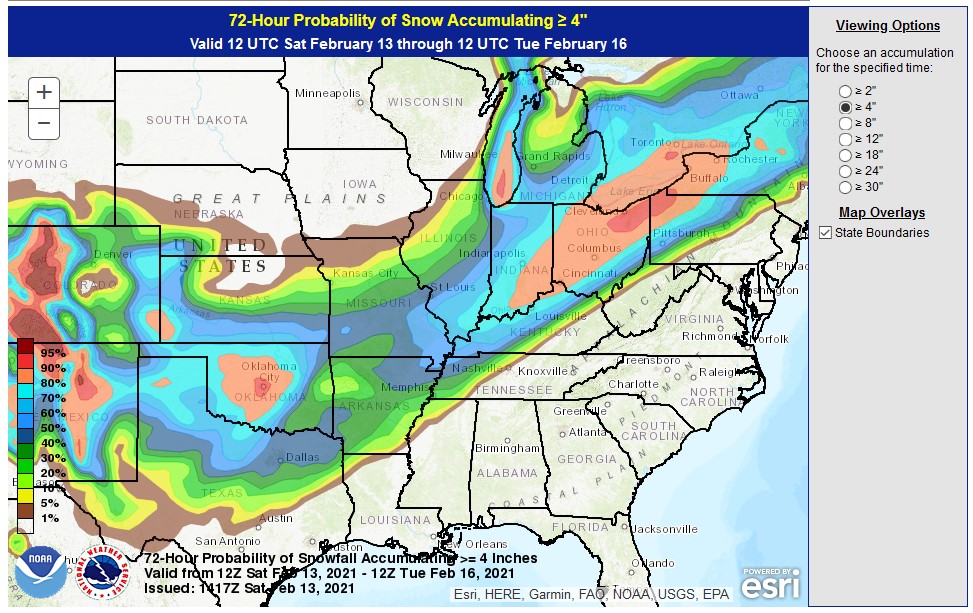

snow

freezing rain

Not only are we dealing with this winter storm, but there is also a severe weather threat. The Storm Prediction Center has a slight risk (level 2 out of 5) of severe thunderstorms across portions of the Florida Peninsula for Sunday.  The main threat is damaging winds, but isolated tornadoes are possible. 

Sources:
NOAA

Pivotal Weather

Filed Under: blog-2

February 8, 2021 By Jennifer Narramore

Meteo Monday – The Polar Vortex!

A frigid air mass has been pushing into parts of the country and you may have heard some rumblings in the news that even more cold air is on its way!  Here are some of the headlines that may have graced your social media feed. 

“Coldest Air of the Season Plunges into the U.S.” 

“An Arctic Air Mass Will Invade the Country”

“Chunks Of The Polar Vortex Will Bring Bitterly Cold Wind Chills”

Oh no!  The Polar Vortex!  Is it here?  AGAIN?!  Run for your lives!

Yes!  The Polar Vortex is here, and it is real!  And we are going to talk about it in this latest version of Meteo Monday!

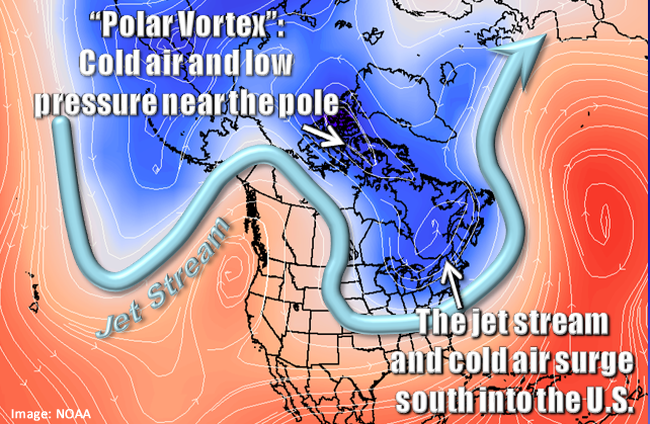
So, what is a polar vortex?  Per the National Weather Service (NWS), “The polar vortex is a large area of low pressure and cold air surrounding both of the Earth’s poles. It ALWAYS exists near the poles, but weakens in summer and strengthens in winter. The term “vortex” refers to the counter-clockwise flow of air that helps keep the colder air near the Poles.”  The vortex always exists, and it is not a new phenomenon.


Image via NOAA.

Winter for a good part of the United States is…cold. However, there are times where it gets much colder than average. Plunges of arctic air masses are caused when the jetstream links up with a piece of the polar vortex and pulls the frigid air southward into the lower 48. Using the term polar vortex to describe these cold shots became mainstream in the winter of 2013/2014 when the national media ran headlines about it. Since then, every cold snap has been labeled “polar vortex.”  It is important to stress that this is not a new term and that meteorologists started using the phrase in 1853!

Why do you see these news headlines about the polar vortex? First of all, The Climate Prediction Center (CPC) 6-10 day outlook over the past few weeks, has consistently shown temperatures across a good part of the country well below average.


Latest 6-10 Day Temperature Outlok from the Climate Prediction Center (as of Feb 8).

Current weather computer models show that the coldest temperatures will likely occur just before sunrise on Valentine’s Day. We want to stress that this is not a forecast, it is a model’s interpretation, and things have changed and will continue to do so as we are still several days away. It is difficult to forecast who will get the coldest air. We have been looking at the model runs for the past several days. They continue to show that frigid temperatures will seep further south. But where exactly will this set up? 

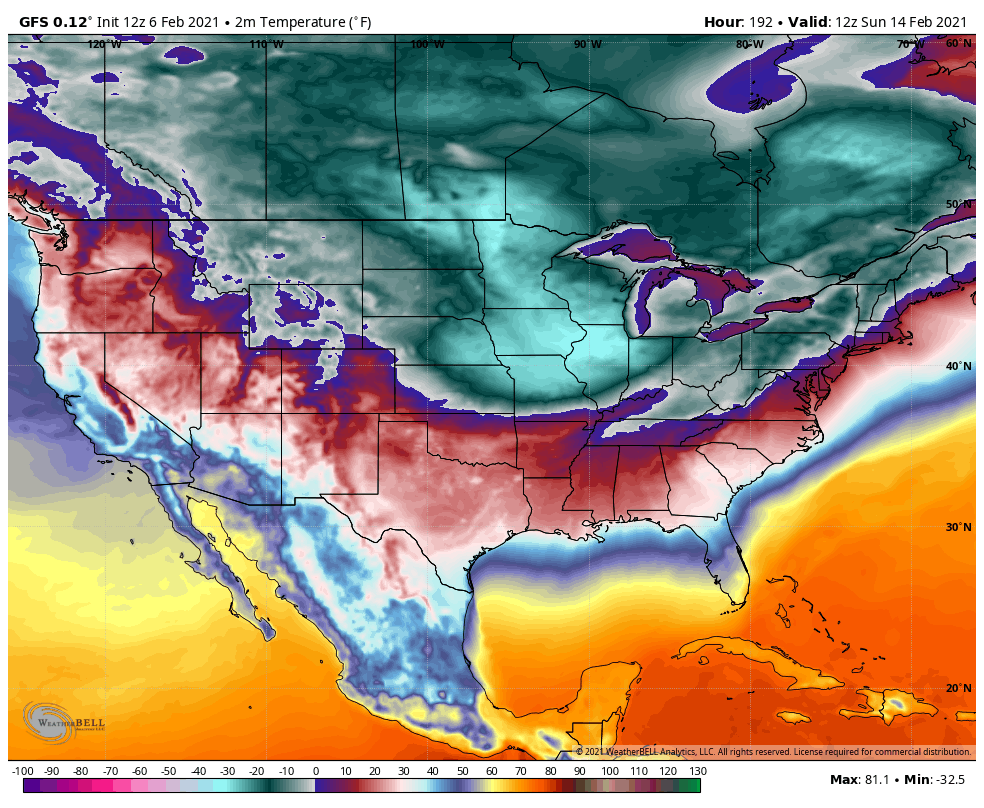
Take a look at the Global Forecast System (GFS Model) slated for 12z (7:00 am EST on the 14th). The image at the top shows the forecast from Saturday, February 6, and the image at the bottom shows the forecast from today (February 8). Notice a shift in where the coldest air will be based on the model runs.  Saturday’s run had the arctic air stretching from the Northern and Central Plains eastward into the parts of the Ohio Valley and the Northeast. Today’s model interpretations are showing the coldest air much further west. This air mass is forecast to stay from west of the Mississippi River through the Northern and Central Plains and over the Rockies. Also a nose of colder air could settle into Texas and New Mexico. 


GFS Model Run from Saturday, February 6. Image credit: WeatherBell Analytics.

GFS Model Run from Monday, February 8. Image credit: WeatherBell Analytics.

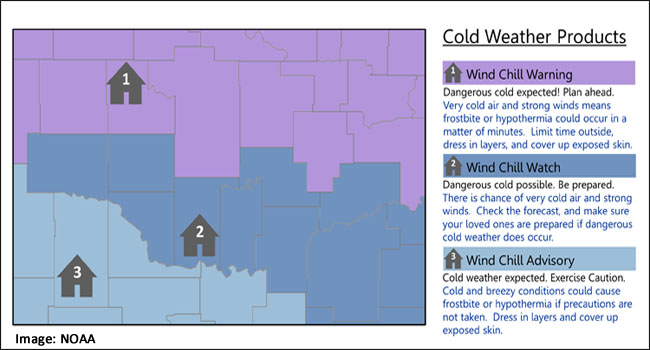
No matter how cold it gets, it is essential each winter season to review your safety plan. Arctic blasts typically occur each season, some worse than others.  And some lasting longer than others.  Arctic air combined with brisk winds can lead to extremely cold wind chill temperatures. Per the NWS, “The wind chill temperature is based on the rate of heat loss from exposed skin caused by wind and cold and is to give you an approximation of how cold the air feels on your body.” The NWS issues Wind Chill products to alert the public of dangerous cold.  


Image via NWS.

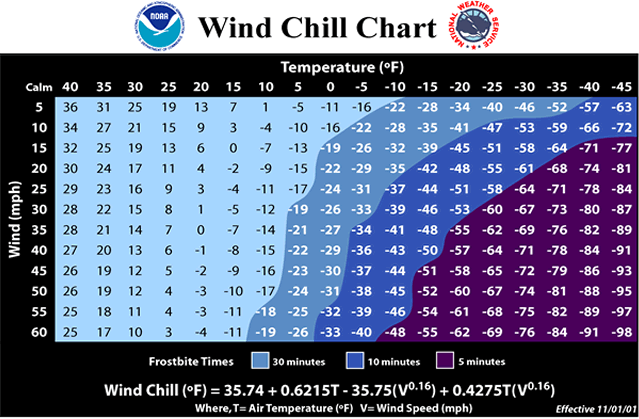
When venturing outside in the extreme cold, make sure to dress in layers. One of the dangers of the bitter cold is frostbite. Per the NWS, “Frostbite happens when the body’s survival mechanisms kick in during extremely cold weather. To protect the vital inner organs, the body cuts circulation to your extremities: feet, hands, nose, etc., which eventually freeze.” If you have to go out, make sure to cover every part of your body.  Stay out of the wind and limit your time outside.  Frostbite can occur within five minutes when wind chill values are -50°F or below. If your body temperature lowers to below 96°F, you have hypothermia. This is a severe health condition, and you must seek medical attention immediately. 


Image via NWS.

Other things to consider when an arctic air mass is on its way:  Protect your pets or farm animals.  Limit their exposure to the cold and make sure they have plenty of food and water. Take precautions to keep the pipes at your home or business from freezing. Keep at least a half tank of gas in your vehicle and prepare a winter car survival kit.  Items to include: jumper cables, a flashlight, first aid kit, a shovel and ice scraper, extra clothes, and blankets. 

So, whether the headline includes the words “polar vortex” or some other frigid phrase, remember it is winter, and periods of extreme cold are nothing new.  The goal is to be prepared and stay safe.  Think warm! Meteorological spring is only a few weeks away!

Sources:

Cold Weather Safety

What is the Polar Vortex? – Weather.Gov

Polar vortex

WeatherBELL Analytics

Climate Prediction Center – 6 to 10 Day Outlooks

Filed Under: blog-3

January 8, 2021 By Jennifer Narramore

Biggest Events of 2020: Derechos

2020 supplied us with at least three large derecho events. What is a derecho? Per the Storm Prediction Center, “A derecho is a widespread, long-lived wind storm. Derechos are associated with bands of rapidly moving showers or thunderstorms variously known as bow echoes, squall lines, or quasi-linear convective systems. By definition, if the swath of wind damage extends for more than 250 miles (about 400 kilometers), includes wind gusts of at least 58 mph (93 km/h) along most of its length, and also includes several, well-separated 75 mph (121 km/h) or greater gusts, then the event may be classified as a derecho.” In our overview, we are delving into the details of the most impactful derechos of the year.

June 3, 2020: Philadelphia Derecho


Composite radar image of the derecho, via Wikipedia.

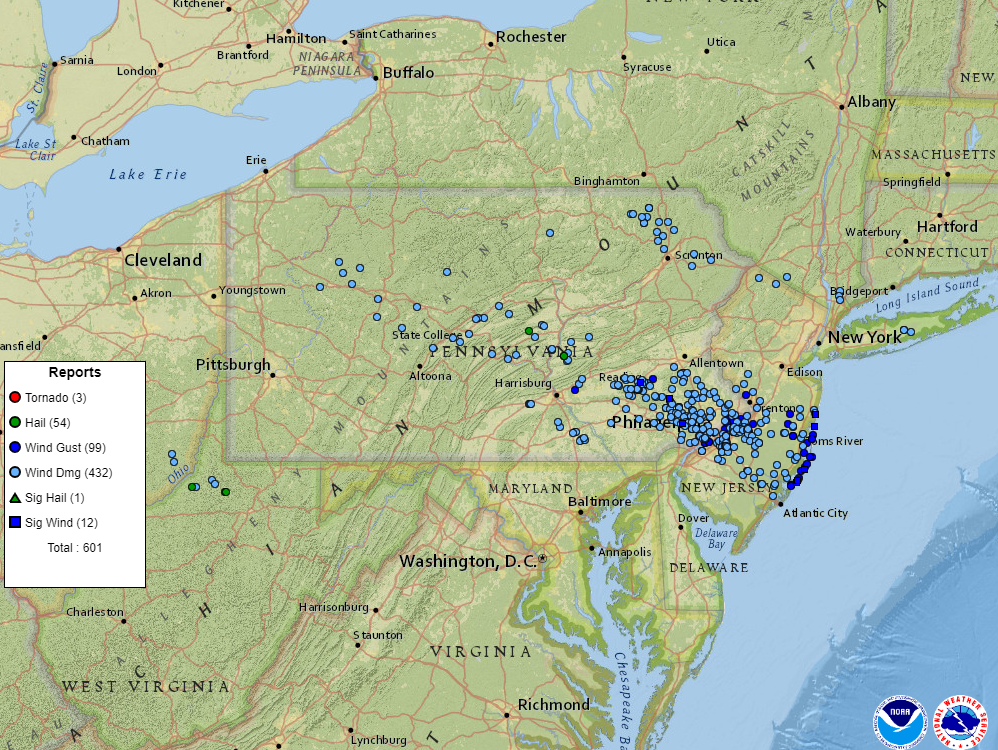
SPC Storm reports.

During the morning and early afternoon hours of June 3, 2020, a derecho marched across Pennsylvania, into New Jersey.  The damage was first reported in Beaver Township, Clarion County, PA where it knocked down several trees. The bow-echo started to grow in size as it marched across Central Pennsylvania, downing trees and power lines across Clearfield, Tyrone, State College, Lewistown, and Hershey. As it moved into the Lehigh Valley, across the Philly Metro Area, and NJ, it was at its strongest and was very destructive. 

  • Length of Damage: 305 miles
  • Highest Measured Wind Gust: 93 mph at Beach Haven, NJ. 
  • Fatalities: 4. 
  • Extensive tree and roof damage reported across highly populated areas of southeastern PA, and NJ. 
  • Later in the afternoon, another round of severe storms hit this same area, prompting a tornado warning for Philadelphia. 
  • Several homes that were under construction were destroyed. 
  • Deadliest derecho to affect this region since 1950. 

Homes under construction in Philadelphia’s Port Richmond neighborhood were toppled by Wednesday’s strong derecho. A resident’s security camera caught the collapse as it happened. More: https://t.co/gg2Fx3um5X pic.twitter.com/gSWrAUd9Bd

— NBC10 Philadelphia (@NBCPhiladelphia) June 3, 2020

June 3, 2020: Central Rockies – Northern Plains Derecho


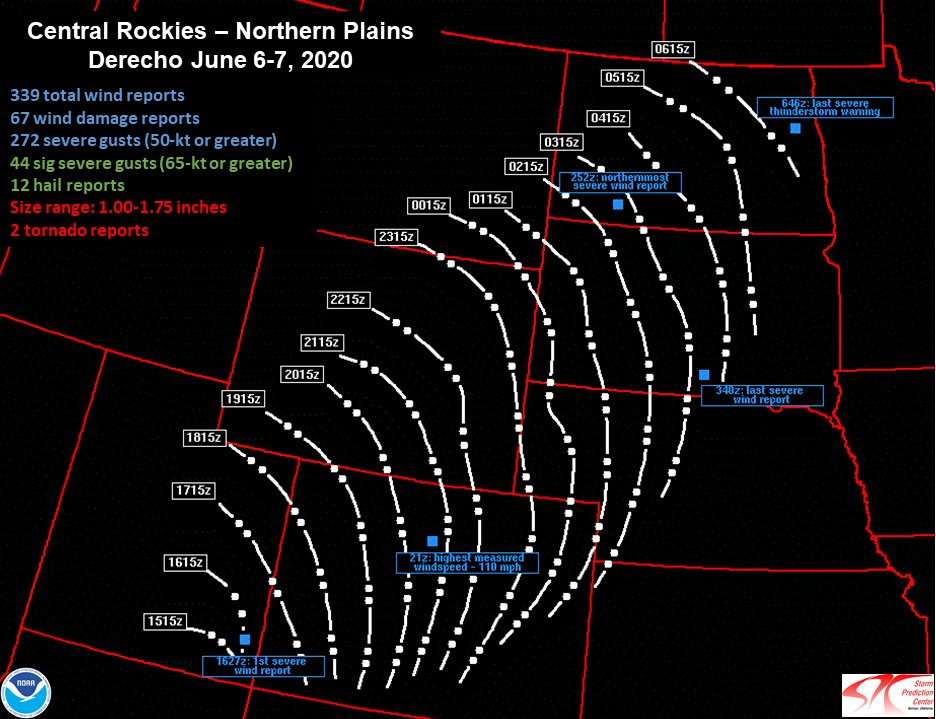
Image via the SPC.

GOES-16 ABI Band 13 (10.3 µm) infrared imagery, 1901 6 June 2020 – 0656 7 June 2020 via CIMSS Satellite Blog.

Rare derecho stretching from Utah to the Dakotas today.

A Rocky Mountain special. pic.twitter.com/tkNC8lLRmj

— Dakota Smith (@weatherdak) June 7, 2020

A very strong upper-level area of low pressure moved through parts of the Rockies and the Plains region on Jun 6-7, 2020.  It triggered a line of storms that brought widespread damaging winds and even a few brief tornadoes to parts of Utah, Colorado, Wyoming, and the Dakotas.  This event was classified as a derecho by the Storm Prediction Center.  This was a rare event for this part of the country. Per a post from meteorologist Elizabeth Leitman on Twitter, there have only been two other derecho events recorded in the Western U.S:  May 31, 1994, and June 1, 2002.

I put together some quick info on Saturday’s derecho event. Only two other derechoes in the Great Basin are well noted in literature. I’ve included storm reports for those events, as well as a derecho frequency map for comparison. Pretty remarkable event! #derecho #wxtwitter pic.twitter.com/d2KZk1Gvmk

— Elizabeth Leitman (@WxLiz) June 7, 2020

  • Severe wind reports expanded 750 miles from far southeast Utah to southwest North Dakota. 
  • For nearly 12 hours, severe winds were produced.
  • Derecho tracked to the northeast at approximately 60 mph.
  • Highest gust was 110 mph at Winter Park Ski Area in Grand County, CO.
  • A peak gust of 78 mph at the Denver airport.
  • 94 mph gust at Butte, SD.
  • NWS Rapid City confirmed two brief tornadoes.  One was near Billsburg, SD and the other hit the Badlands/White River KOA campground in Jackson County.

Billboard snapped off at 1898 S Broadway Denver (CBS-Denver) via NWS Denver Summary.

#sdwx #cows Was pretty mesmerizing watching this shelf cloud with QLCS circulations embedded in it come at us. The cows were looking to us for shelter I think! pic.twitter.com/6gRhaxvuvB

— Michael Snyder (@SeattleWXGuy) June 7, 2020

August 10, 2020: Midwest Derecho

This derecho was by far the worst of the year.  It was also the worst one to occur in eight years. It began in eastern Nebraska and dissipated in southern Michigan/northwestern Ohio.  Iowa was by far the hardest hit, where estimated wind gusts of 140 mph caused major damage to homes, trees, corn crops, and cellphone towers. This derecho was the costliest severe thunderstorm event in US history, causing an estimated $7.5 billion in damage! It was also the second-costliest natural disaster to impact the US in 2020, falling behind Hurricane Laura, which produced $14.1 billion in damage. Cedar Rapids, IA  was the hardest-hit area. It was here where the 140 mph winds tore apart a large apartment complex, destroyed half of the trees in town, and caused extensive damage to many buildings. 


A composite radar of the Derecho moving across the Midwest, via NWS Chicago.

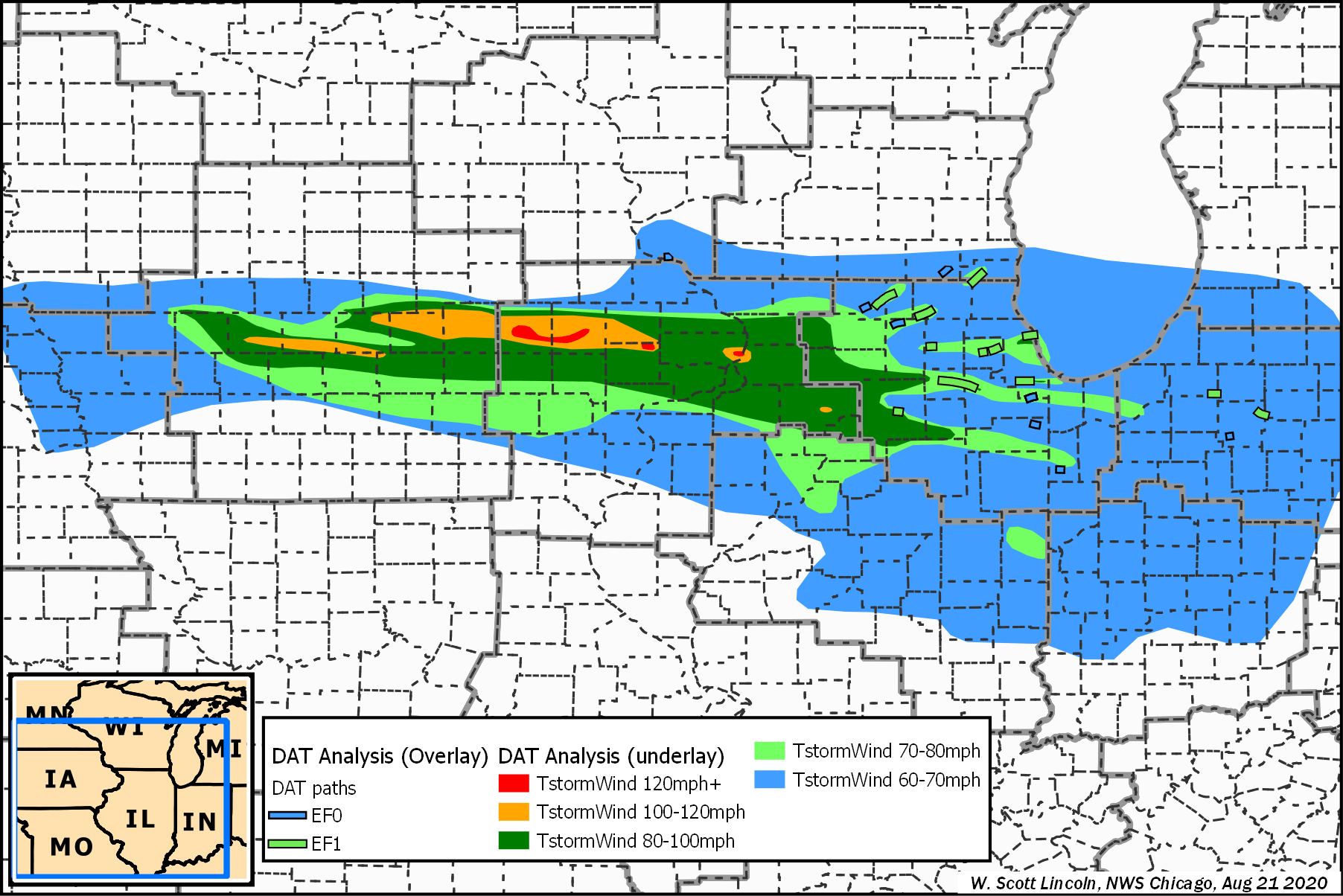
The swath of wind damage, mapped out by the NWS surveys via NWS Chicago.
  • Length of Damage: 770 miles
  • Highest Measured Wind Gust: 126 mph in Atkins, IA. 
  • 25 tornadoes confirmed. 
  • 14 million acres of crops destroyed in IA. 
  • 100 million bushels (3.52 million cubic meters) worth of grain storage and processing infrastructure destroyed. 
  • Fatalities: 4, Injuries: 115.
  • $7.5 billion in damage. 
  • 150-foot communications tower collapsed.

The sun setting behind a leveled cornfield near Adel, IA, via NWS Des Moines.

Sources

3 June 2020 Derecho

Derecho slams Philadelphia area with destructive 80 mph winds

Iowa derecho in August was most costly thunderstorm disaster in U.S. history

Midwest Derecho – August 10, 2020, Updated: 10/8/20 12 pm (NWS Quad Cities)

August 10, 2020: Derecho Brings Widespread Severe Wind Damage Along with Several Tornadoes (NWS Chicago) 

https://en.wikipedia.org/wiki/August_2020_Midwest_derecho

Derecho Facts from The Storm Prediction Center

June 6 2020 Derecho (NWS Denver) 

June 6, 2020 Derecho (NWS Cheyene) 

June 6, 2020 Derecho (NWS Rapid City)

Derecho in South Dakota « CIMSS Satellite Blog 

Was Saturday’s Wind Storm Colorado’s First-Ever Derecho? via The Denver Post

Filed Under: blog-2

January 4, 2021 By Jennifer Narramore

Biggest Events of 2020: Wildfires & Pyrotornadoes

Several major wildfires ripped across the West Coast states in 2020. These fires prompted mass evacuations and major damage. 2020 could also be known as the “year of the fire tornado”. Below is a recap of the five largest fires of the year and the historic pyrotornadoes!

August Complex Fire

  • Size: 1,032,648 acres burned.
  • Location: California. 
  • Start Date: August 16, Containment Date: November 12. 
  • Fatalities: 1, Injuries: 2
  • Made up of 37 fires that were started by lightning strikes, and grew into one large fire. 
  • 935 structures destroyed. 
  • The largest fire complex in California history.

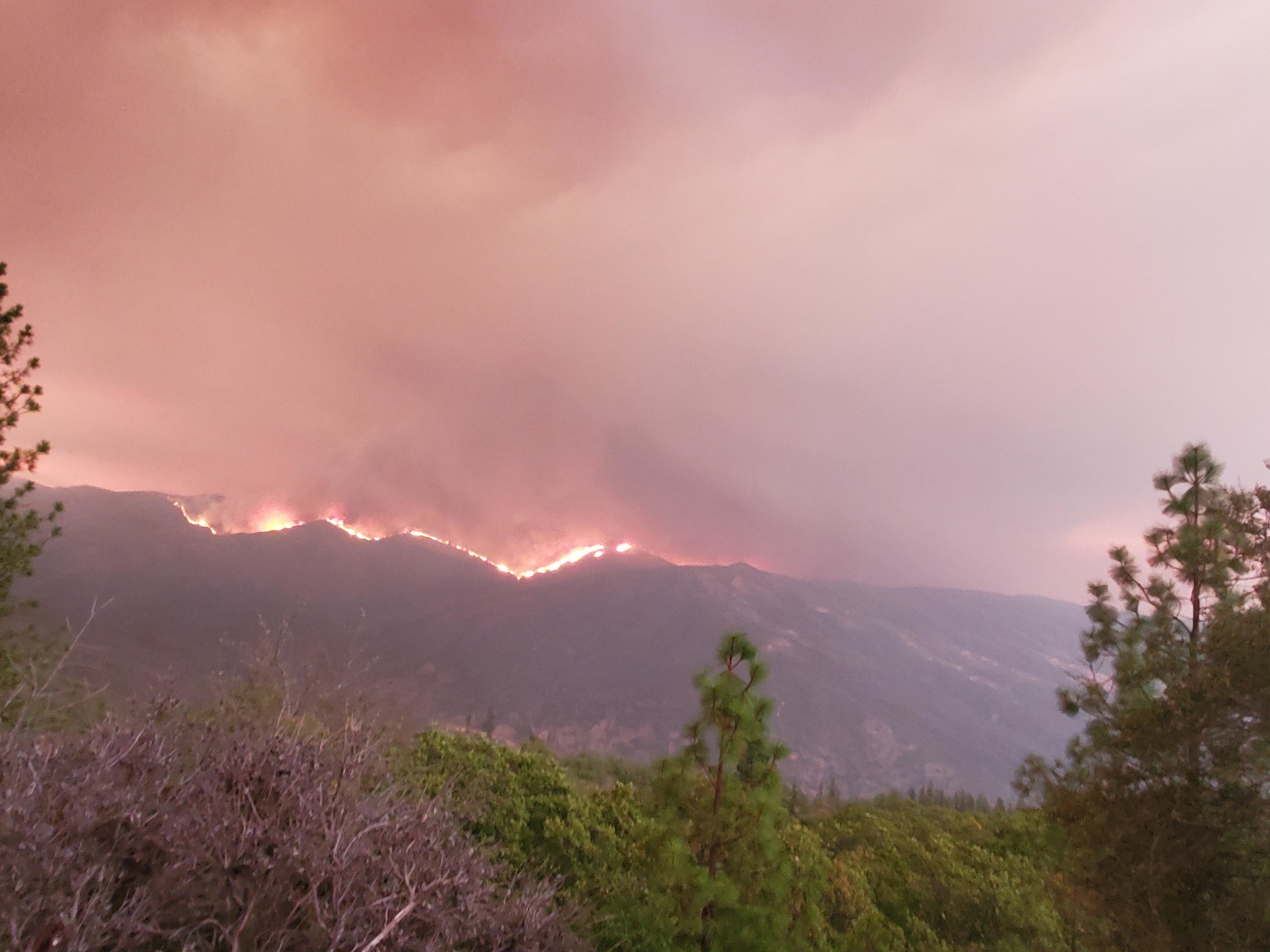
“View of the August 2020 Doe Fire (the largest fire in the August Complex), on August 19, as seen to the south of Forest Highway 7 of the Mendocino National Forest.” Via the US Forestry Service.

Santiam Fire

  • Size: 402,592 acres burned. 
  • Location: Oregon. 
  • Start Date: September 8, Containment Date: December 10.
  • Fatalities: 5
  • Made up of three fires that were started by lightning strikes, and grew into one large fire. 
  • Most of the towns of Detroit and Gates were destroyed.
  • Over 1,500 structures destroyed.

View of the Santiam fire from Salem, Oregon on September 8th. Photo by Bruhmoney77 on Wikipedia.

SCU Lightning Complex Fire

  • Size: 396,524 acres burned.
  • Location: California.
  • Start Date: August 16, Containment Date: October 1. 
  • Injuries: 6
  • Several large fires all sparked by lightning combined into one. 
  • 222 structures destroyed. 
  • Third largest fire complex in California history. 

Photo of the SCU Lightning Complex Fire taken by Governor Gavin Newsom, on August 22.

Creek Fire

  • Size: 379,895 acres burned.
  • Location: California.
  • Start Date: September 4, Containment Date: December 24
  • Injuries: 29.
  • Nearly 900 structures destroyed.
  • Produced the largest ever documented pyroculmulonimbus cloud. 
  • Produced two confirmed fire tornadoes near Huntington Lake. 

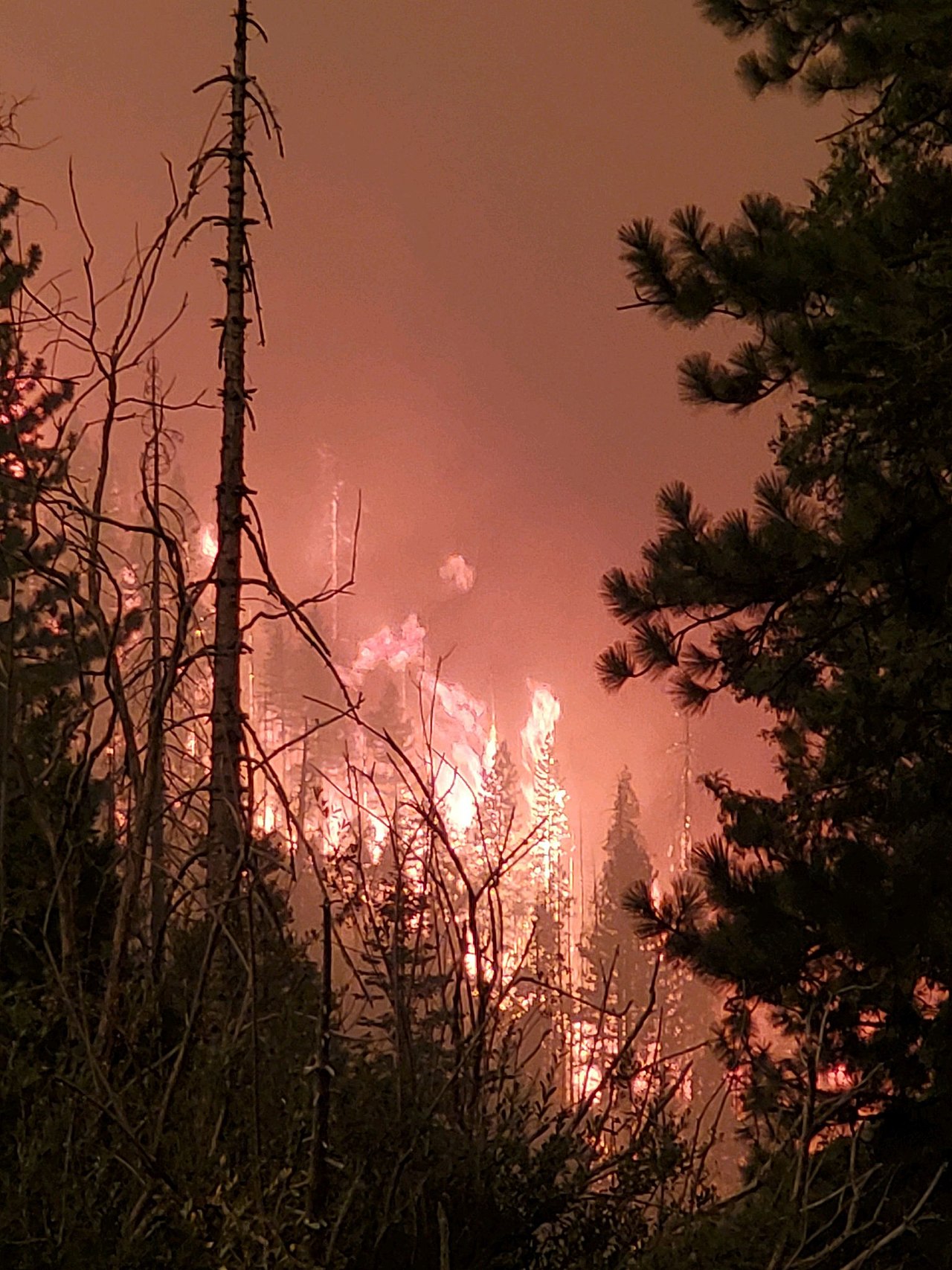
Photo via CAL FIRE showing trees burning during the Creek Fire.

LNU Lightning Complex

  • Size: 363,220 acres burned. 
  • Location: California 
  • Start Date: August 17, Containment Date: October 2. 
  • Fatalities: 5, Injuries: 5.
  • Several fires started by lightning and grew into one large fire. The thunderstorms that produced the lightning were caused by the remnants of Tropical Storm Fausto. 
  • 1,491 structures destroyed. 
  • Fourth largest fire complex in California history.

Photo of the Hennessey and Spanish Fires burning toward lake Berryessa, before they combined into the LNU Complex, on August 18. Photo by Dripwoods, via Wikipedia.

Pyrotornadoes

Similar to a “normal” tornado, pyrotornadoes are spawned by a mesocyclone. This mesocyclone, however, occurs within a pyrocumulus cloud, caused by a forest fire. These happen each year, particularly in California.  For the first time on record, a pyrotornado was documented and officially recorded as a tornado in the SPC database. At the time of writing, five pyrotornadoes have been officially documented in California, in 2020.

Loyalton-Fire Tornadoes:

Three tornadoes were confirmed in Lassen County, California on August 14, and August 15. In fact, a tornado warning was issued for the pyro-tornadoes on August 15. The August 14 pyrotornado was rated EF-1. It was on the ground for less than a half-mile and snapped several pine trees. On August 15, two tornadoes were confirmed. The strongest was an EF-1 that touched down for about 100 yards and snapped several aspen trees. The second one was rated EF-Unknown. This photogenic vortex tracked across an area of burned sage brush for 3.16-miles. It produced no damage. 

image of the fire tornado in Lassen Co., CA today. divine. gorgeous. unbelievable. pic.twitter.com/jr9zj89tTh

— Morgan J. Fuld // royalNYR54 (@mjfuld54) August 16, 2020

Creek Fire Tornadoes:

On September 5, the Creek Fire produced two tornadoes. The strongest was rated EF-2, with estimated winds at 125 mph! It tracked for 12 miles from near Mammoth Pool, to near the Chawanakee Joint Elementary School, in Madera County. It snapped and uprooted many trees, and some were even de-barked. The second pyrotornado occurred near Huntington Lake. Several trees were uprooted and snapped in EF-1 fashion along the mile-long path. 

pic.twitter.com/0rTuyB518m

— NWS Hanford (@NWSHanford) September 24, 2020

Sources

Fire tornado erupts in California, triggering rare warning – The …www.washingtonpost.com › weather › 2020/08/16 › ca… 

2020 Western United States wildfire season

LNU Lightning Complex fires

August Complex fire

Creek Fire (2020)

SCU Lightning Complex fires

Santiam Fire

https://www.ncdc.noaa.gov/stormevents/listevents.jsp?eventType=%28C%29+Tornado&beginDate_mm=08&beginDate_dd=01&beginDate_yyyy=2020&endDate_mm=09&endDate_dd=30&endDate_yyyy=2020&county=ALL&hailfilter=0.00&tornfilter=0&windfilter=000&sort=DT&submitbutton=Search&statefips=6%2CCALIFORNIA

Filed Under: Uncategorized

January 4, 2021 By Jennifer Narramore

Biggest Events of 2020: December 16-17 Winter Storm


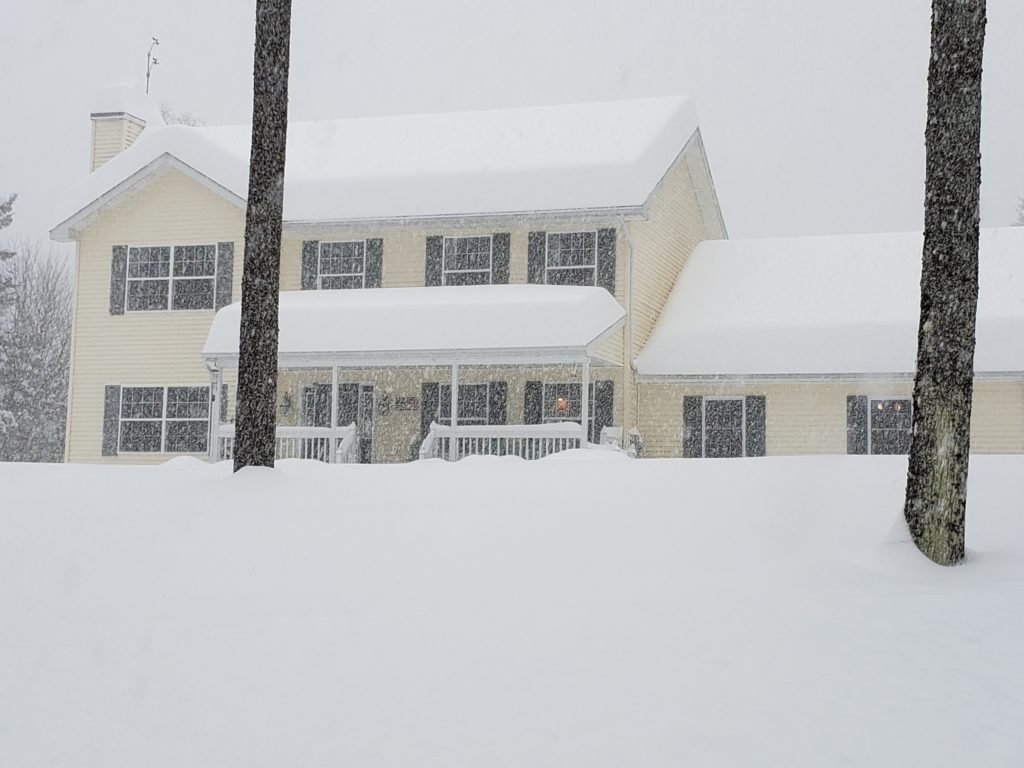
Images from Doug A. Smith of The Storm Report radio affilliate WNUB.  These photos are from Grantham, NH which received 34 inches of the snow!  The dogs don’t seem to mind!

Parts of the Mid-Atlantic, the Northeast and New England were walloped with a winter storm on December 16-17, 2020. Some areas walked away with four feet of snow! Others experienced a mix with some ice accumulation. Here is The Storm Report Recap! 

Total snowfall map via the National Weather Service (NWS).


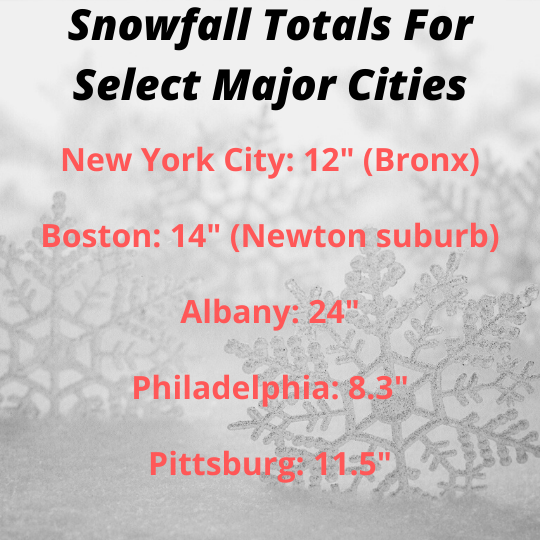
Data from the NWS.

Total Ice Accumulation Map via the NWS.

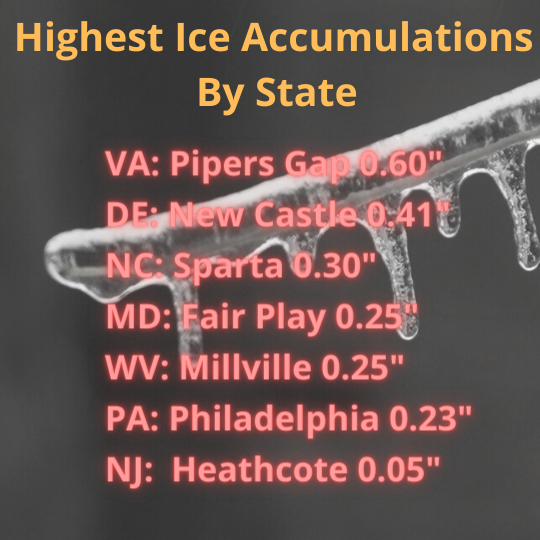
Data from the NWS.

Record-Setter

As of 7AM this morning, @flyIPT made history – most snow from a single storm on record. Additional snow during the day today could widen the gap even further. #PAwx pic.twitter.com/fi7ghs4DQw

— NWS State College (@NWSStateCollege) December 17, 2020

Thursday's snowfall at Concord was the highest single day snowfall on record and the second biggest snowstorm on record. Records at Concord go back to 1868. #nhwx pic.twitter.com/2nTG7b2saU

— NWS Gray (@NWSGray) December 19, 2020

Tweets from the storm

Snowfall timelapse from Apalachin, NY!

There were two trail cameras in time lapse mode. One appears to have died before the event, the other was buried in the backyard. After some digging I found it. Joy #nywx pic.twitter.com/BV6ku08F4Z

— Ron Murphy (@isixtyfive) December 18, 2020

Ice accretion on Carter Mountain VA!

Some of the thickest #ice (up to an inch) I’ve ever seen in person atop Carter Mountain, overlooking Charlottesville! This is from the #IceStorm on Wednesday.

It reminds me of the ice storm of 1994 and 2003 in the Mid-Ohio Valley (lower elevation). 🧊 ⁦@NWS_BaltWash⁩ pic.twitter.com/DSRkLLaXlc

— Josh Fitzpatrick (@JoshFitzWx) December 18, 2020

Plow truck takes out a mailbox in State College, PA!

That's OK snow plow, I didn't need that mailbox! pic.twitter.com/Fdi62ncq1V

— Jesse Ferrell (@WeatherMatrix) December 17, 2020

Look who knocked on the door in Binghamton, NY!

Pic from friends near Binghamton 😮 pic.twitter.com/H7eg15cEC8

— Andrew Banas (@AndrewWHAM) December 17, 2020

Snow pics from Ludlow, VT!

Here are some great pictures from Ludlow, Vermont, where they got an astounding 44” of snow from Winter Storm Bailey! pic.twitter.com/KEDwkNp2hs

— Jordan Chaplinski (@JordanChappy3) December 17, 2020

People eating dinner as snow falls in NYC!

What a photo.

In Manhattan last night. 📸 by Hiroko Masuikehttps://t.co/trgIm7CPLK pic.twitter.com/Kcxf9Pw0Hj

— Mike Baker (@ByMikeBaker) December 17, 2020

Stories from the storm

Two were killed in a 66 car pile up on Interstate 80 in Clinton, County, PA. This occurred during the afternoon of Wednesday, December 16, 2020 on the westbound lane of the interstate. Per the Pennsylvania State Police, one fatality was from the crash. Another was as a result of a medical issue.

Photos show deadly 66-vehicle pile-up in Pennsylvania during snowstorm https://t.co/iyR9zjI7cc pic.twitter.com/ehslSXXSHw

— New York Post (@nypost) December 17, 2020

I 80 multi vehicle fatal crash pic.twitter.com/eQPkGSjSJq

— Troopers Angela Bieber and Mark Reasner (@PSPTroopFPIO) December 17, 2020

A man in Oswego, NY was buried in his car for 10 hours! Per an article in the Associated Press, Kevin, Kresen, 58 had driven off the road after passing a snow plow. Per state police, he had been “plowed in by a truck.” From the article, “If he was in there for another hour his body temperature would have gone lower, and I’m convinced he wouldn’t have made it,” State Police Sgt. Jason Cawley, who rescued the man, said in an interview.
With the help of a stranger, parents-to-be Christine and Jay Barker were able to get the hospital in the midst of the winter storm to safely welcome their baby boy into the world. The couple from Roslindale, MA were buried in snow when the Christine realized she was in labor.  She reached out to a community page and stranger came to the rescue.  Per WCVB-TV, “There was one particular guy that ended up coming that we met only because he came, showed up at our house with a mask on, with a shovel, ready to help. Pat Hines, Pat Hines, our knight in shining armor.”

https://youtu.be/yt-i3D2uWI4

Sources

https://www.wearecentralpa.com/news/local-news/police-release-names-of-those-who-died-in-i-80-pileup/

https://pittsburgh.cbslocal.com/2020/12/16/clinton-county-crash-interstate-80/

https://apnews.com/article/new-york-man-buried-car-snow-plow-9c9ac44da5d6059a9fe3bf843ceeee48

https://www.wcvb.com/article/stranger-helps-family-clear-snow-when-mother-goes-into-labor/35020775

Filed Under: Uncategorized

  • 1
  • 2
  • 3
  • Next Page »

Real Personalities

When looking to add a trusted source for weather, you want someone who can connect with your audience.   Our meteorologists are also on-air personalities.    The Storm Report team delivers a fresh sound with relatable information to get through the day.  We are your staff meteorologists.

The Storm Report

Follow us on:

Real Passion

We love weather.   No two days are the same.   That fuels our passion.   When weather is serious, you will hear it in our voices.    No text-to-speech computer forecasts.   No robotic audio.   Humans connect with humans and that is what radio is all about.

Real Life

When your community hosts special events, the weather is always a factor.   We weave timely information into your forecast when it comes to fairs, parades, fundraisers or remote broadcasts.    If your weather is sponsored, we are the spokesperson, helping your client earn results.

Copyright © 2026 thestormreport.com